Mikao Usui
Usui Sensei · 1865 – 1926
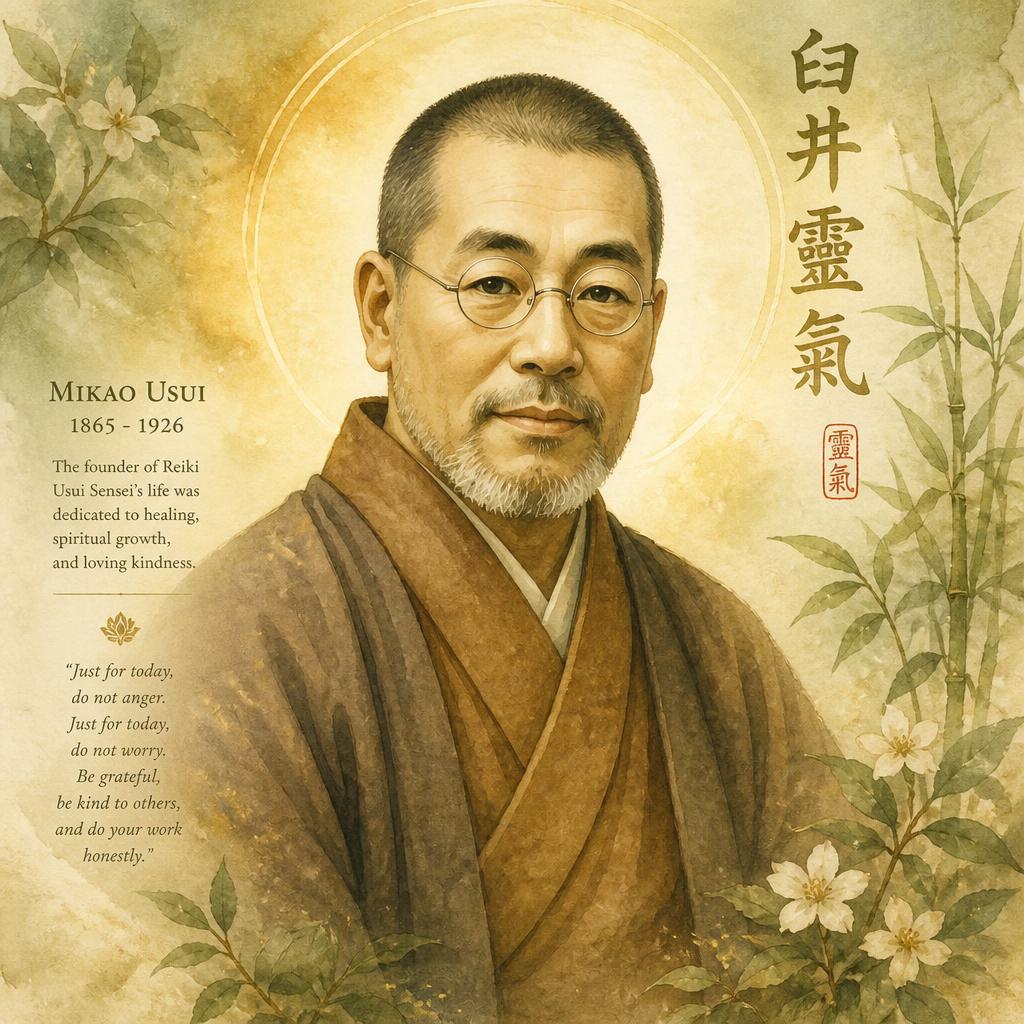
Mikao Usui, or Usui Sensei as he is called by Reiki students in Japan, was born August 15, 1865 in the village of Taniai in the Yamagata district of Gifu prefecture, near present-day Nagoya, Japan.
He had an avid interest in learning and worked hard at his studies. As he grew older, he traveled to Europe and China to further his education. His curriculum included medicine, psychology and religion as well as the art of divination, which Asians have long considered to be a worthy skill. Usui Sensei also became a member of the Rei Jyutu Ka, a metaphysical group dedicated to developing psychic abilities. He had many jobs — civil servant, company employee, journalist — and he helped rehabilitate prisoners. Eventually he became the secretary to Shinpei Goto, head of the department of health and welfare who later became the mayor of Tokyo. The connections Usui Sensei made at this job helped him to also become a successful businessman.
The depth and breadth of his experiences inspired him to direct his attention toward discovering the purpose of life. In his search he came across the description of a special state of consciousness called An-shin Ritsu-mei — a state in which one is always at peace regardless of what is taking place in the outer world, and from which one completes one's life purpose. The experience of peace simply wells up spontaneously from within, a type of enlightenment.
Usui Sensei dedicated his life to achieving this state. He found a Zen teacher and practiced Zazen for three years, but had not been successful. His teacher suggested a more severe practice — one in which the student must be willing to die in order to achieve An-shin Ritsu-mei.
"A powerful light suddenly entered his mind through the top of his head, and he felt as if he had been struck by lightning."
In February 1922, he went to Kurama yama, a sacred mountain north of Kyoto, to fast and meditate until he passed to the next world. He was not looking to discover a method of healing — he was seeking that special spiritual state. There is a small waterfall on Kurama yama where even today people stand under the water to activate the crown chakra; Japanese Reiki Masters believe Usui Sensei may have used this meditation as part of his practice. As time passed he became weaker and weaker. At midnight of the twenty-first day, in March 1922, a powerful light suddenly entered his mind through the top of his head and he fell unconscious.
As the sun rose, he awoke filled with an extremely enjoyable state of vitality. A miraculous, high-frequency spiritual energy had displaced his normal consciousness and replaced it with an amazingly new level of awareness. He experienced himself as the energy and consciousness of the Universe; the enlightenment he had sought had been given to him as a gift.
Running down the mountain to tell his Zen master, he stubbed his toe on a rock. He placed his hands over the toe, as anyone would, and healing energy began flowing from his hands all by itself. The pain disappeared and the toe was healed. Usui Sensei realized that, in addition to the illuminating experience, he had also received the gift of healing — and that this was his life purpose: to be a healer and to train others.
In April 1922, he moved to Tokyo and started a healing society he named Usui Reiki Ryoho Gakkai (Usui Reiki Healing Method Society). He opened a Reiki clinic in Harajuku, Aoyama, Tokyo, where he taught classes and gave treatments.
Most of his system developed in 1923 after the Great Kanto earthquake and tsunami, which devastated Tokyo. With so many people in need of healing, Usui Sensei developed many of his practitioner techniques — Gassho, Byosen scanning, Reiji-ho, Gyoshi ho, Seishin-to-itsu — and a formal attunement method, Reiju kai, that made transferring the Reiki ability much faster. He also developed the three Reiki symbols we receive today in Reiki II, which he called Okuden. He did not have a Master symbol.
Usui Sensei gave many attunements to each student, not just one. This process continually refined and developed one's ability to channel Reiki energy, making it more versatile and able to heal more deeply. He taught that there is no limit to the quality and effectiveness of the Reiki energy available in the universe, and that an important purpose for all students was to continually seek to improve the quality of the energy they channel.
He called his system Shin-Shin Kai-Zen Usui Reiki Ryo-Ho (The Usui Reiki Treatment Method for Improvement of Body and Mind), or simply Usui Reiki Ryoho. His training had three degrees: Shoden (First Degree, what the West calls Level I), Okuden (Inner Teaching, Level II), and Shinpiden (Mystery Teaching, Master level).
Demand grew so great that in 1925 he built a larger clinic in Nakano, Tokyo, and began to travel so he could teach and treat more people. He directly taught more than 2,000 students and initiated twenty Shihan, each approved to teach and give Reiju in the same way he did. The Japanese government issued him a Kun San To award for his honorable work. While traveling to Fukuyama to teach, he suffered a stroke and died on March 9, 1926. His grave is at Saihoji Temple in Suginami, Tokyo.
Chujiro Hayashi
Hayashi Sensei · 1880 – 1940
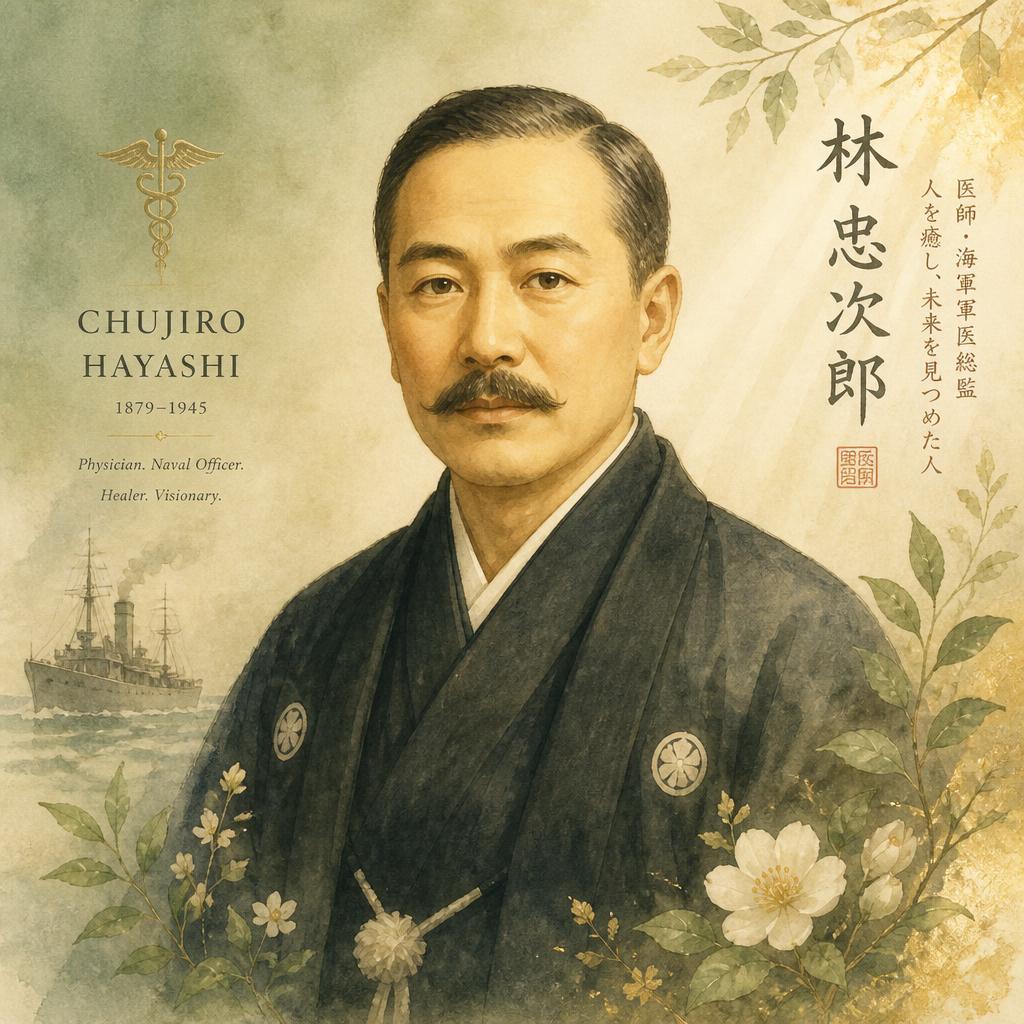
Before his passing, Usui Sensei had asked Chujiro Hayashi Sensei to open his own Reiki clinic and to expand and develop Reiki Ryoho based on his previous experience as a medical doctor in the Navy. Motivated by this request, Hayashi Sensei started a school and clinic called Hayashi Reiki Kenkyukai (Institute). After Usui Sensei's passing he left the Gakkai.
At his clinic in Tokyo, he kept careful records of all the illnesses and conditions of his Reiki patients, and which hand positions worked best to treat each one. From these records he created the Reiki Ryoho Shinshin (Guidelines for Reiki Healing Method) — part of a class manual given to his students, to be used only if the practitioner was not yet able to use Byosen scanning to find the best hand positions. Many of his students received their Reiki training in return for working in his clinic.
Hayashi Sensei also changed the way Reiki sessions were given. Rather than have the client seated in a chair and treated by one practitioner as Usui Sensei had done, he had the client lie on a treatment table and receive treatment from several practitioners at a time. He created a new, more effective system for giving Reiju (attunements). To increase the value his students received while he was traveling, he developed a new method of teaching Reiki in which he taught both Shoden and Okuden (Reiki I & II) together in one five-day seminar — each day including two to three hours of instruction and one Reiju. Following the Usui method, students were still encouraged to receive Reiju regularly from their local Shihan to continue refining the energy they channeled.
"He died honorably on May 11, 1940."
Because of his trip to Hawaii in 1937–38 prior to the Japanese attack on Pearl Harbor, Hayashi Sensei was asked by the Japanese military to provide information about the location of warehouses and other military targets in Honolulu. He refused and was declared a traitor. This caused him to "lose face," meaning he and his family would be disgraced and ostracized from Japanese society. The only solution was seppuku (ritual suicide), which he carried out. He died honorably on May 11, 1940.
After this, Hayashi Sensei's wife Chie Hayashi took over the clinic and ran it for some years, but eventually she retired; with no one to take over, the clinic came to an end. It is likely that some of his students continued to teach, but most have passed on. In 1999 it was discovered that Chiyoko Yamaguchi Sensei, a Shinpiden (Master) student of Hayashi Sensei, was still alive and practicing. She was encouraged to teach and began doing so. Chiyoko Yamaguchi passed on in 2003 — a final living thread to the original Japanese lineage.
Hawayo Takata
Takata Sensei · 1900 – 1980
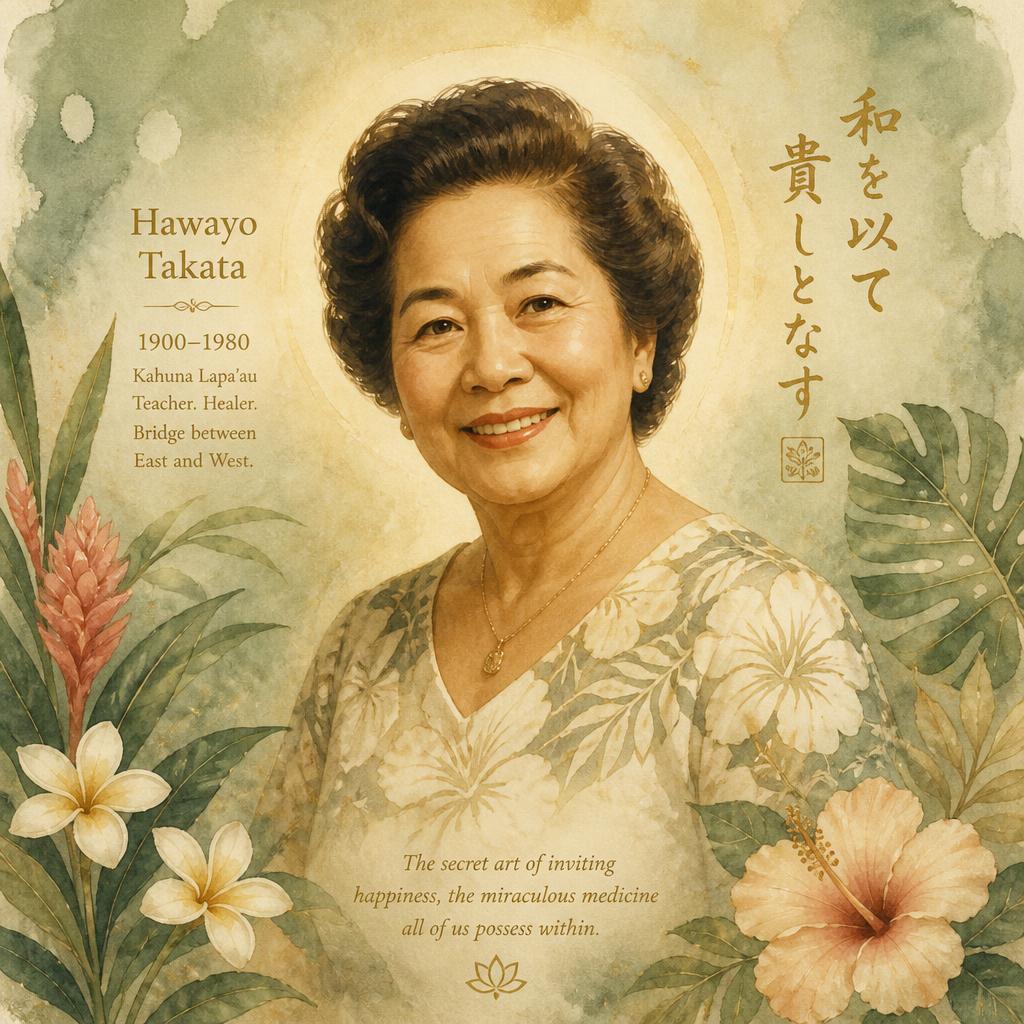
The following is a summary of Takata Sensei's version of her early years leading up to her contact with Reiki at the Hayashi clinic, drawn from an interview that appeared in The (San Mateo) Times, May 17, 1975, titled "Mrs. Takata Opens Minds to Reiki" by Vera Graham.
She stated that she was born on December 24th, 1900, on the island of Kauai, Hawaii. Her parents were Japanese immigrants and her father worked in the sugar cane fields. She eventually married the bookkeeper of the plantation where she was employed — Saichi Takata — and they had two daughters. In October 1930, Saichi died at the age of 34, leaving Mrs. Takata to raise their two children alone.
In order to provide for her family, she had to work very hard with little rest. After five years she developed severe abdominal pain and a lung condition, and suffered a nervous breakdown. Soon after this, one of her sisters died, and it was Takata Sensei's responsibility to travel to Japan, where her parents had resettled, to deliver the news. She also felt she could receive help for her health issues in Japan.
After informing her parents and attending the funeral, she entered a hospital and was diagnosed with a tumor, gallstones, appendicitis, and asthma. She was told to prepare for an operation but opted to visit Hayashi Sensei's clinic instead.
Mrs. Takata was unfamiliar with Reiki but was impressed that the diagnosis of Reiki practitioners at the clinic closely matched the doctor's at the hospital. She began receiving treatments — two practitioners worked on her each day. The heat from their hands was so strong that she thought they were secretly using some kind of equipment. Seeing the large sleeves of the Japanese kimono worn by one, she thought she had found the place of concealment. Grabbing his sleeves one day she startled the practitioner, but, of course, found nothing. When she explained what she was doing, he began to laugh and then told her about Reiki and how it worked.
"In four months she was completely healed."
Mrs. Takata got progressively better and in four months was completely healed. She wanted to learn Reiki for herself. In the spring of 1936 she received First Degree Reiki from Dr. Hayashi. She then worked with him for a year and received Second Degree Reiki. Mrs. Takata returned to Hawaii in 1937, followed shortly thereafter by Hayashi Sensei and his daughter, who came to help establish Reiki there. In February 1938, Hayashi Sensei initiated Hawayo Takata as a Reiki Master.
Takata Sensei practiced Reiki in Hawaii, establishing several clinics — one of which was located in Hilo on the Big Island, where she gave Reiki sessions from 1939 to 1949. She gave treatments and initiated students up to Reiki II. She became a well-known healer and traveled to the U.S. mainland and other parts of the world teaching and giving treatments. She was a powerful healer who attributed her success to the fact that she did a lot of Reiki on each client — often multiple treatments, each sometimes lasting hours, and treating difficult cases every day for months until the client was healed. To help with this process, she often initiated members of a client's family so they could give Reiki to the client as well.
Takata Sensei had a unique way of practicing and teaching Reiki that was noticeably different from how Usui Sensei or Hayashi Sensei had practiced and taught. She said that the Japanese style was too complicated and would be difficult for the Western mind to learn, so she simplified the system. This included the development of her own hand position system, which she called the foundation treatment — eight hand positions on the abdomen, shoulders, and head, with additional positions for the back if the client needed them.
This varied considerably from how Usui Sensei and Hayashi Sensei had practiced. They taught Byosen scanning as the way to find the best hand positions for treatment and considered it the most important practice technique for a student to master after the practice of continually receiving repeated Reijus. Yet Takata Sensei never taught this technique. She also did not teach any of the other methods used by Usui Sensei and Hayashi Sensei such as Gassho, Reiji-ho, Kenyoku, Gyoshi-ho, or Koki-ho. Additionally, she had a different attunement method for each level of Reiki, taught her students that the attunements empowered the symbols, and taught a Master symbol given to Master students. In her system, the Master symbol was needed in order to give attunements, and could also be used during Reiki sessions for healing. She did not encourage her students to receive as many attunements as possible — she taught that just one set of four attunements for Reiki I, one or two for Reiki II, and one for the Master level were all that were necessary.
The simplified system that Takata Sensei taught was effective and has proven to produce valuable results for her students and their clients. Because of this, Takata Sensei can be considered an important innovator of Usui Reiki Ryoho.
One thing that is important to understand is that if it were not for Takata Sensei, Reiki would most likely have fallen into obscurity and never have been practiced by people all over the world; even in Japan it would have been mostly unknown. After World War II, the United States required Japan to unconditionally surrender, placing the U.S. in complete control of Japan. One of the conditions required was that all those practicing any kind of healing be licensed. Some healing groups did get licensed, but the Usui Reiki Ryoho Gakkai chose to go underground rather than be controlled by a licensing board. Members were not to talk to anyone outside their group about Reiki and would only practice with each other. This made it difficult for anyone — including the Japanese — to find out about Reiki. Because it became very difficult for new members to join, the membership slowly declined; this problem exists even now.
Because Takata Sensei learned Reiki in Japan and returned to Hawaii and began teaching before World War II, she prevented Reiki from being lost. She was a great teacher and promoter, and taught Reiki classes all over Hawaii and in many parts of the U.S. mainland. Before her passing, she taught 22 Reiki Masters who carried on the tradition — the lineage from which nearly all Western Reiki, including the teachings of this school, descends.